How-To Guides

How to Create Educational Videos from Research Papers Using AI

From my experience, the hardest part isn’t the technology—it’s translating a paper’s argument into a story with a beginning, middle, and end.
By BrainyDocuments TeamSeptember 22, 202516 min read
How to Create Educational Videos from Research Papers Using AI

How to Create Educational Videos from Research Papers Using AI

TL;DR

Turn dense research papers into engaging educational videos without drowning in details. Start with a crisp paper-to-script workflow, use AI to draft narration and visuals, and then assemble with AI-assisted editing. Focus on accuracy, accessibility, and pacing—and you’ll turn academic content creation into a scalable, repeatable process. This guide covers practical steps, workflows, and pro tips to go from a research paper to a polished video your audience will actually learn from.

Introduction

If you’ve ever tried to explain a complex paper to a colleague, you know the challenge: the core ideas are buried under jargon, figures, and pages of methodological nuance. Yet, in today’s academic and professional worlds, video is often the fastest way to explain a concept clearly and memorably. Educational AI, combined with smart workflows, can transform a dense research paper into a short, digestible video that still respects the science.

From my experience, the hardest part isn’t the technology—it’s translating a paper’s argument into a story with a beginning, middle, and end. AI tools can handle the heavy lifting: drafting scripts, generating visuals, and producing narrations. But you still need to curate, fact-check, and tailor the content to your audience. When done right, you’ll get more people engaged with your work, improve learning outcomes, and create reusable, scalable content for “academic content creation” pipelines.

In this guide, I’ll walk you through a practical, repeatable workflow to go from research paper to video. You’ll learn how to extract the essence of a paper, script it in an accessible way, generate visuals and narration with AI, assemble and refine the video, and ensure quality and accessibility. I’ll pepper in real-world notes—Pro tips and quick notes—so you can avoid common pitfalls and move fast without sacrificing accuracy. We’ll also touch on metrics you can use to gauge impact and ways to manage licensing and ethics in AI-assisted production.

Key terms you’ll see here include “research paper video,” “paper to video conversion,” “educational ai,” and “academic content creation.” These aren’t just buzzwords; they’re part of a practical workflow you can apply to most scientific papers, from computer science to biology.

Pro tip: If you’re new to this, start with shorter, simpler papers or extract a single, compelling finding to test your pipeline. It’s easier to refine process and storytelling on a small scale before you tackle larger, more complex studies.

Quick note: Always verify AI-generated content against the original paper. AI can misinterpret nuanced claims or misrepresent data unless you intentionally supervise the outputs.

Main Content Sections


1) From Paper to Script: Extracting the Core Narrative

The first step is to distill the paper into a clean, story-friendly outline. The goal isn’t to cram every detail into the video; it’s to convey the central question, approach, results, and implications in a way that’s both accurate and engaging.

What to do

  • Read with a specific lens: Identify the problem statement, the hypothesis or research question, the methodology at a high level, the key findings, and the limitations. Note any graph or figure that clearly communicates an idea.
  • Create a one-page summary: Write 3–5 sentences capturing the core thesis. List 3–5 takeaways or “sound bites” you want the audience to remember.
  • Build a storyboard: Map out 8–12 scenes. Typical scenes include: Hook (why this matters), Background (context), Approach (methods at a high level), Key Finding (what they discovered), Evidence (representative figures/graphs), Implications (what it means), Limitations (caveats), and Takeaway (the bottom line and future directions).
  • Decide on visuals per scene: Link each scene to a figure, chart, or concept you’ll illustrate. Decide whether you’ll show the original figure, a simplified diagram, or a short animation.
  • Draft a script outline: Convert each scene into a short paragraph or a few bullet points. Use plain language and short sentences. Plan where you’ll insert on-screen text or captions.

A practical example: You’re turning a paper on a new neural network architecture into a 6-minute video. Scene ideas:

  • Hook: “Can AI think faster than humans? Here’s a new architecture that speeds up learning.”
  • Background: A simple analogy of layers as “filters” for data.
  • Approach: High-level description of the architecture, with a simplified block diagram.
  • Key Findings: Performance improvements on benchmark X, with a speedup factor.
  • Evidence: A clean, easy-to-read chart showing accuracy vs time.
  • Implications: Why this matters for real-world tasks.
  • Limitations and Future Work: Where this approach might struggle.
  • Takeaway: A compact summary and a call to action (read the paper for details).

Pro tip: Treat figures as storytelling aids. If a graph communicates a result more clearly than words, plan to show it with a short narration that explains what the axis means and why the trend matters.

Quick note: When you mention specific numbers (e.g., accuracy, speedups), double-check against the paper. If the original figure is dense, consider a simplified caption and an animated highlight to guide the viewer’s eye.

From my experience, spending extra time on the storyboard pays off. A well-designed storyboard reduces rework later in production and helps you maintain a consistent pace across the video.


2) AI-Enhanced Production: Script, Visuals, and Narration

With your storyboard and outline in place, you can leverage AI to produce the video components efficiently. The goal is to preserve scientific accuracy while leveraging AI to improve clarity and engagement.

2.1 Script drafting with AI

  • Use an AI writing assistant to draft the narration from your outline. Provide prompts that describe the scene, the audience level, and the required tone (concise, curious, and neutral).
  • Build a voice-friendly script: Prefer short sentences, active voice, and transitions that guide the viewer. Include on-screen prompts where you’ll show figures or diagrams.
  • Fact-check and annotate: After the draft, verify each claim against the paper. Add inline citations or on-screen references when appropriate.

Pro tip: Ask the AI to “explain this concept to a first-year graduate student in 2 sentences” for parts that feel too technical. Then rephrase for a general audience.

Quick note: Don’t rely on AI for exact wording of critical results without human review. Accuracy matters more than speed here.

2.2 Visuals: diagrams, figures, and overlays

  • Diagram generation: For complex methods, generate simplified diagrams that convey the flow. You can describe the diagram to an AI image generator or use diagramming tools to create clean block diagrams.
  • Figure-to-visuals: If the paper has key figures, consider recreating them with clearer visuals. You can redraw with simplified axes, labels, and color palettes to highlight the main message.
  • Animations: Subtle motion can aid understanding. Animate a data flow, an expensive step in a pipeline, or a comparison between models using simple transitions. Avoid flashy effects that distract from the science.
  • Audience-friendly notation: Replace dense mathematical notation with intuitive icons or short textual explanations. If you must show equations, display them briefly with a simple, verbal cue.

Example: A paper on a novel attention mechanism might translate to a short visual with blocks labeled “Input,” “Query,” “Key,” “Value,” and arrows showing how attention weights shift. Add a 4-second animation of how attention scores change over time, with a caption: “Attention weights adapt to context.”

2.3 Narration: AI voices and human-in-the-loop

  • AI voice options: You can use AI voice engines to generate a natural-sounding narrator. For educational content, choose a voice that’s clear, friendly, and easily understood. Always review and adjust pacing to match the script.
  • Human-in-the-loop: Even with AI voices, add a human voiceover for critical sections or for a short intro/outro. This improves perceived credibility and engagement.
  • Emphasize clarity: Use varied pacing, emphasis on key terms, and occasional pauses to let ideas sink in.

Pro tip: If your platform supports it, generate a transcript first, then have AI create a natural-sounding narration that aligns with the written text. This helps keep timing synced with visuals.

Quick note: Voice licensing matters. If you’re using AI-generated voices, verify licensing terms for commercial or educational use and provide proper attribution if required.

2.4 Editing and assembly: AI-assisted workflows

  • Automated editing: Use AI-powered editors to assemble scenes, select best takes, and adjust timing to keep the video within your target length. AI can also help with noise reduction, color correction, and simple cut automation.
  • Captioning and accessibility: Generate captions automatically and correct them for accuracy. Accessibility improves comprehension and widens your audience.
  • Versioning: Create different lengths (e.g., 3-minute summary, 6-minute deep dive) from the same script. AI can adapt visuals and narration for each length while preserving core messages.

From my experience, a tight 6-minute video with a 1-minute introduction, 3 minutes of core content, and a 30–60 second takeaway works well for academic audiences. If you need deeper exploration, you can create a 12-minute version with expanded sections.

Pro tip: Keep a consistent template for thumbnails, opening visuals, and on-screen typography. Consistency builds recognition and reduces production time.

Quick note: Always preview on different devices (mobile, laptop, tablet) to ensure visuals remain legible and pacing feels natural on smaller screens.

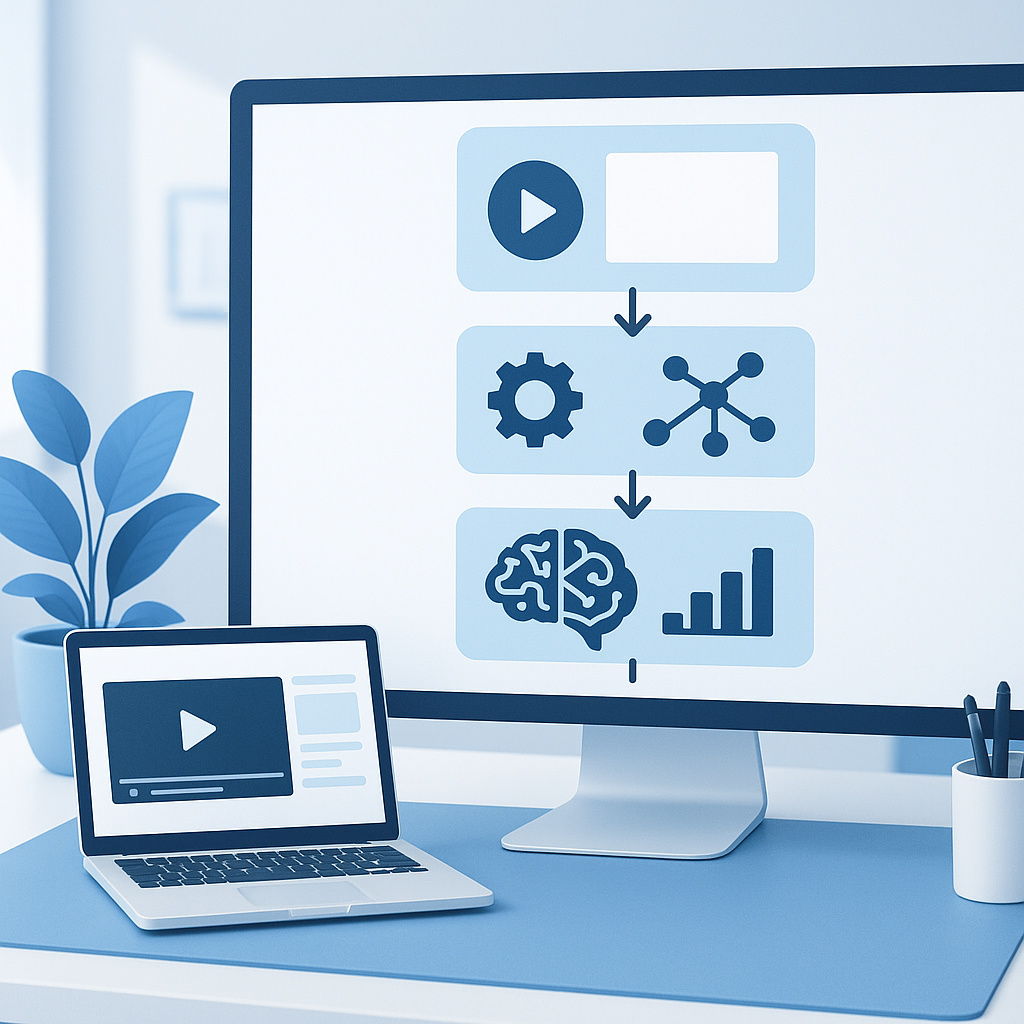
2.5 Practical pipeline example

  • Step 1: Outline and storyboard completed (8 scenes).
  • Step 2: AI draft script generated and edited for accuracy.
  • Step 3: Visuals created: simplified diagrams for methods, data-driven charts for results, a clean background for transitions.
  • Step 4: Narration produced with AI voice; human reviewer adjusts intonation.
  • Step 5: Video assembled; captions added; accessibility checks performed.
  • Step 6: Review by a subject-matter expert or colleague; final tweaks.
  • Step 7: Publish with a descriptive title, chapter markers, and clear references.

Time investment example: A 6-minute video might take a couple of hours for a first draft, plus 1–2 hours for review and adjustments. With a streamlined template, you can produce new videos in less time as you refine your process.


3) Quality, Accessibility, and Ethical Considerations

This is the make-or-break part of educational content creation. You’re aiming for accuracy, clarity, and ethical use of AI.

3.1 Accuracy and fact-checking

  • Double-check data points, statistical claims, and model descriptions against the original paper and supplementary material.
  • Use a “two-person check” approach: the author of the script and a separate reviewer validate the final narrative and visuals.
  • Retain precise terminology where it matters, but pair it with accessible explanations to avoid misinterpretation.

Pro tip: Create a quick “fact-check checklist” for every video segment. Include items like “Is this claim supported by the figure?”, “Are units and scales correct?”, and “Is the interpretation consistent with the paper’s limitations?”

Quick note: If a paper includes contradictory or nuanced conclusions, acknowledge these nuances in the video rather than presenting a single, confident takeaway.

3.2 Accessibility: captions, transcripts, and math-friendly formats

  • Captions: Provide accurate captions, including notation when spoken. Review for sync with narration.
  • Transcripts: Offer a full transcript in addition to captions for searchability and accessibility.
  • Math and equations: When necessary, pair equations with plain-English explanations or narrated verbal summaries. For math-heavy content, consider a slide showing the equation with a simple, intuitive interpretation.
  • Color and contrast: Use color palettes with strong contrast and color-blind-friendly options. Add descriptive alt text to visuals.

Pro tip: Use inclusive design from the start. Add navigable scene markers in the video description and provide a downloadable “key ideas” one-pager for offline study.

3.3 Licensing, attribution, and ethical use of AI

  • Use licensed or openly licensed materials for visuals if you repurpose figures. If you recreate diagrams, note that they’re simplified representations and not the exact original figures.
  • Attribution matters. Include a slide or caption with full citation of the paper and any sources for visuals or data dashboards.
  • AI ethics: Be transparent about the use of AI in production. A brief note in the video description or an end-card can help manage audience expectations and address concerns.

Pro tip: Keep a simple license matrix for your own library of visuals and scripts. It’s easier to track what’s allowed in educational contexts and where you need to seek permission.

3.4 Engagement and impact evaluation

  • Metrics to track: watch time, drop-off rate, retention at key moments (e.g., after the main finding), completion rate for longer videos, and click-throughs to the paper or supplementary materials.
  • A/B testing: If you produce multiple versions (e.g., different openings or visuals), compare engagement metrics to identify what resonates with your audience.
  • Feedback loops: Encourage viewers to ask questions or request clarifications. This can guide future videos and help you refine your storytelling.

From my experience, videos that explicitly connect a paper’s claim to a practical implication—especially a real-world scenario—see higher engagement. Audiences appreciate crisp takeaways and clear “why it matters” moments.

Pro tip: End with a concise “What this means in practice” slide for practitioners or students who want to apply the finding quickly.


FAQ Section

  1. What exactly is “paper to video conversion,” and who should use it?
  • Paper to video conversion is the process of turning a research paper into a short, educational video. It’s useful for students, educators, researchers sharing findings with a broader audience, and institutions building scalable coursework or outreach materials.
  1. How long does it take to produce a typical video from a paper?
  • A lean, well-structured 6-minute educational video can take roughly 4–8 hours from outline to final edit, depending on the complexity of the paper and the level of polish you want. If you’re using a repeatable template and a well-tuned AI workflow, you can reduce that to 2–4 hours per video over time.
  1. How can I ensure accuracy when using AI to draft scripts and visuals?
  • Always start with a careful fact-check briefing. Use the paper as the ground truth, and have a human reviewer compare the AI-generated script and visuals with the original content. Generate a short list of “claims to verify” and cross-check each item against the paper. Include citations on-screen where appropriate.
  1. What about complex math and equations?
  • For math-heavy content, you can explain key equations in plain language, show simplified diagrams that capture the intuition, or annotate the equation step-by-step with a voiceover. If a full derivation is essential, consider linking to a supplemental resource or providing an accompanying “math appendix” video.
  1. How do I handle licensing and attribution?
  • Use open licenses whenever possible for visuals, and clearly cite the paper in the video description. If you recreate visuals, note that they’re your own representation and provide a reference to the original work. For AI-generated narration, check the license terms of the voice model and adhere to any usage restrictions.
  1. How important is accessibility, and how do I optimize it?
  • Accessibility is essential for broad reach and compliance with educational standards. Provide accurate captions, transcripts, alt text for visuals, and consider a written summary with key takeaways. Use high-contrast visuals and avoid relying solely on color to convey information.
  1. How do I measure the impact of my educational videos?
  • Track metrics like watch time, retention rate, completion rate, and engagement (likes, comments, shares). You can also measure downstream effects, such as the number of viewers who read the cited paper or implement ideas in coursework. Consider surveys to capture qualitative feedback on clarity and usefulness.
  1. Can AI-produced videos replace human experts or educators?
  • They shouldn’t replace them. AI accelerates production and improves accessibility, but expert review remains essential. A human-in-the-loop ensures accuracy, ethical considerations, and effective pedagogy. Use AI to scale and standardize your process, then rely on subject-matter experts for final validation.
  1. How can I adapt the workflow for different audiences?
  • Start by defining your audience’s background level and goals. For undergraduates, favor broader explanations and more visuals. For researchers, keep the technical depth and provide pointers to the original work. Create audience-specific versions, using the same core narrative but adjusting language and visuals accordingly.
  1. What platforms are best for publishing research-to-video content?
  • You’ll typically publish on platforms where educational content thrives, such as university channels, YouTube, or educational repositories. Add chapters or timestamps to facilitate navigation and enable viewers to find the section they care about quickly.

Note: The above answers reflect a practical, field-friendly approach. Feel free to adapt the depth and style to align with your institution’s guidelines or your audience’s needs.


Conclusion

Turning a research paper into an educational video is not about dumbing down science; it’s about translating complexity into clarity without sacrificing rigor. AI can accelerate the process—from scripting and visuals to narration and editing—so you can produce more content, reach a broader audience, and reinforce learning through multiple modalities. The key is a disciplined workflow: extract the paper’s core narrative, craft a compelling storyboard, leverage AI for production while maintaining tight human oversight, and prioritize accessibility and ethical use.

From my experience, the most impactful videos emerge when you treat “paper to video conversion” as a storytelling exercise as much as a technical one. A strong narrative, clear visuals, and precise citations turn a dry PDF into a digestible, memorable learning resource. Build templates, rehearse your script, and iterate based on feedback. With time, you’ll develop a scalable pipeline that supports ongoing academic content creation, letting you convert more research into educational value—one well-crafted video at a time.

Key takeaways

  • Start with a tight paper summary and a scene-by-scene storyboard before you touch visuals.
  • Use AI to draft scripts and generate visuals, but always verify accuracy with the original paper.
  • Prioritize accessibility: captions, transcripts, and math-friendly explanations improve learning outcomes.
  • Maintain ethical standards: attribution, licensing, and transparency about AI use matter.
  • Measure impact with engagement metrics and feedback, then refine your approach for future papers.

Pro tip: Create a reusable “video kit” for recurrent topics (e.g., a standard intro, a consistent visual style, a citation slide template). Over time, this reduces friction and speeds up your paper-to-video workflow across multiple papers.

Quick note: If you’re sharing your process publicly, consider publishing a short behind-the-scenes write-up or a companion “methodology” video. Viewers often appreciate transparency about AI-assisted production and the steps you take to preserve scientific integrity.

Whether you’re an educator, a researcher, or a student, AI-enabled educational content creation can unlock new ways to learn from and disseminate research. With a thoughtful approach, you can turn dense papers into engaging, trustworthy videos that resonate with diverse audiences—and you’ll do it at scale.

Share this article

Stay Updated with AI Document Processing

Get the latest insights on AI-powered document conversion, productivity tips, and industry updates.

No spam. Unsubscribe at any time.

Related Articles