How to Transform Academic Lectures into Student-Friendly Study Materials
TL;DR
Lectures are the starting point, not the finish line. By capturing core ideas, distilling them into concise study materials, and leveraging academic ai tools, you can turn dense lectures into decks, flashcards, and cheat sheets your brain loves to study. The workflow I’ll share helps you go from notes to a personalized study toolkit—faster, more retention-friendly, and easier to reference during exams. Expect better recall, less last-minute cramming, and materials you can reuse across courses.
Introduction
If you’ve ever walked out of a lecture knowing you heard something valuable but not knowing how to keep it without writing pages of notes, you’re not alone. Professors spin through complex ideas, proofs, and case studies in 50 minutes, leaving you with a jumble of facts and vague impressions. The hard part isn’t listening—it’s transforming what you heard into study materials that actually stick.
From my experience coaching students and designing AI-assisted study workflows, the trick is to create a repeatable process that starts with capturing the essentials and ends with practice-ready formats. When you turn lectures into structured lecture notes, concise summaries, flashcards, and diagrams, you’re not just creating notes—you’re building a personal study system. And with a dash of academic ai to automate repetitive parts, you can scale this approach across multiple courses without burning out.
In the next sections, you’ll find a practical, 3-step workflow you can apply to any lecture, plus templates and tips you can adapt to your learning style. We’ll cover how to extract learning objectives, distill content into bite-sized formats, and leverage AI tools to speed up the process while keeping everything accurate and aligned with your syllabus. By the end, you’ll have a repeatable method you can reuse each semester.
Pro tip: Start small. Pick one lecture this week and apply the process end-to-end. You’ll quickly see how much time you save later when you’re studying for finals.
Quick note: Always check with your institution about recording permissions. If recording isn’t allowed, you can work from slide decks, provided you have the lecturer’s permission to share your notes with classmates.
Main Content Sections
1) Capture and Distill: From Lecture to Core Concepts
Turning a lecture into usable study materials begins with capturing what truly matters and discarding what doesn’t. This step sets the foundation for every format you’ll build later.
What to do
-
Get the basics right
- Record if allowed or take high-quality notes during the lecture.
- If recording, use a clear mic setup and a quiet room; consider audio enhancement after the fact.
- Save slides or a slide deck, if the instructor shares them, as anchors for your notes.
-
Transcribe and annotate
- Use a reliable transcription tool to convert the recording into text. Then clean up the transcript: fix misheard terms, remove filler, and separate main ideas from examples.
- Mark timestamps for key moments or transitions (e.g., “Introduction of concept X at 12:34”). This makes it easy to jump back later.
-
Identify learning objectives and big ideas
- From the lecture, write down the stated objectives (if any) and infer the core concepts the instructor emphasizes.
- Create a short concept list: term, definition, why it matters, and how it connects to other ideas.
-
Extract key terms and mechanisms
- Build a glossary of essential terms with simple definitions.
- For problem-heavy topics, sketch the main steps or mechanisms that drive solutions (e.g., how a algorithm runs in best/worst case).
-
Create a baseline study sheet
- Put the core ideas into a one-page summary per lecture. Use headings like What, Why, How, and Example.
- Include 3–5 practice questions that help you test understanding right away.
-
Pro tip: Time-stamped notes are your best friend
- As you summarize, attach a brief note of what the takeaway is at each timestamp. For example: “12:34 – Big-O notation: complexity explanation with a simple example.” Later, you can click the timestamp to revisit the concept quickly.
-
Quick note: Don’t try to capture every detail
- The goal is to distill into something you can study from, not recreate the lecture. If something seems tangential, skip it for now and come back after you’ve built your core materials.
From my experience, a solid distillation step dramatically reduces the cognitive load when you later study. When students pause to distill, they report up to a 40–60% decrease in time spent re-familiarizing themselves with material before exams.
A concrete example
- Course: Introduction to Algorithms
- Lecture focus: Divide-and-conquer and recurrence relations
- Core concepts captured: Master Theorem, recurrence examples, time complexity intuition
- Distilled outputs: a 1-page “Concept Sheet” with definitions, a quick worked example of a recurrence, and 5 short-answer prompts to test recall.
Pro tip: Build a one-page “concept map” that visually links terms like recurrence, base case, merge sort, and Big-O. Visuals reinforce memory far more reliably than long prose.
2) Turn Notes into Student-Friendly Study Materials
Once you’ve captured the core ideas, it’s time to transform them into the formats you’ll actually study with. A mix of formats helps you study from multiple angles: recognition, recall, application, and synthesis.
What formats to create (and when to use them)
-
Lecture notes (condensed)
- A clean, structured version of your baseline study sheet. Use bullet points, numbered steps, and short definitions.
- Use a consistent layout: Objective, Core Concepts, Key Terms, Examples, Common Pitfalls, Quick Quiz.
-
Summaries (per topic)
- Write a 2-4 sentence summary that captures the essence of a lecture segment. If you’re studying for a specific exam, tailor the summary to emphasize what’s likely to be tested.
-
Flashcards (active recall)
- Create Q&A pairs for definitions, formulas, and typical problem setups.
- Use a spaced repetition schedule to maximize retention. Most students benefit from 10–20 new flashcards per lecture, reviewed over several days.
-
Concept diagrams and mind maps
- Draw nodes for each concept and connect related ideas with labeled arrows. This helps you see relationships (cause/effect, prerequisite concepts, categories).
-
Formula sheets and cheat sheets
- A single-page reference with key formulas, rules, and quick derivations. Keep it to a page or two so it’s easy to memorize.
-
Practice questions and worked solutions
- Develop 5–15 practice questions with fully worked solutions. Include variations (different inputs, edge cases) to test flexibility.
-
Study plan and micro-sprints
- Break down the material into study sessions with time-boxed goals (e.g., 25 minutes of flashcards, 15 minutes of diagram drawing, 20 minutes of practice problems).
Pro tip: Use templates to speed up production
- Create reusable templates for your notes, flashcards, and diagrams. For example:
- Notes template: Section header, Objective, Core Concepts, Key Terms, Examples, Quick Quiz.
- Flashcard template: Question, Answer, Hint, Related Concepts.
- Diagram template: Concept node, Link labels, Example annotation.
Quick note: Consistency beats quality alone. A consistent format makes it easier to skim, retrieve, and review under time pressure.
From my experience, combining multiple formats for a single lecture (notes + flashcards + diagrams) improves long-term retention. Students who used a 3-format approach reported higher recall in end-of-term checks compared to those who used notes alone.
An actionable workflow (simple to implement)
- Start with a 1-page concept sheet (as described in Section 1).
- Create 5–10 flashcards and 1 diagram that captures the main relationships.
- Write a 150–300 word summary focusing on the key ideas and their relevance to the course outcomes.
- Build 5 practice questions with solutions, and check your answers after 24 hours.
- Transfer everything into a personal study hub (Notion, Obsidian, or a simple folder structure), with tags by course and module.
Practical example
- Course: Linear Algebra
- After distillation: a concept sheet covering vectors, span, basis, linear independence, and rank.
- Study materials produced: 15 flashcards (definitions and properties), a vector space diagram, a short summary of the key theorems, and 8 practice problems.
Pro tip: Pair up with a study partner to exchange materials. You’ll often spot missing links or unclear explanations, which improves your overall set.
3) AI-Powered Workflows: Acceleration, Quality, and Accessibility
AI can speed up repetition-heavy tasks and help tailor materials to your study style. The goal isn’t to replace your understanding but to augment it—freeing you to focus on comprehension, application, and synthesis.
What you can do with academic ai
-
Transcription and early drafting
- Use transcription AI to convert lectures into text quickly. Then review and annotate to correct mistakes and fill gaps.
- Quick note: always verify critical terms, formulas, and names; AI can misinterpret specialized vocabulary.
-
Summarization and highlighting
- Generate executive summaries of sections and extract key points. You can ask the AI to produce a taxonomy: definitions, theorems, examples, and counterexamples.
-
Glossary and term-definition extraction
- Have the AI extract terms with simple definitions, plus links to related concepts. This makes your glossary consistent.
-
Automated Q/A and practice questions
- Prompt the AI to generate flashcards or practice questions (with difficulty levels). Then curate and adjust to your course’s exam style.
-
Diagram and visualization generation
- Use AI tools to generate simple diagrams or concept maps from your notes. Then refine by hand to ensure accuracy and readability.
-
Study plan automation
- Based on your syllabus and lecture pace, the AI can propose a study plan with recommended review intervals, target dates, and workload balance.
Recommended tools and workflows
- Transcription: Descript, Otter.ai, or built-in algorithms in your note app.
- AI summarization and Q/A: GPT-4, Claude, or similar large language models. Use prompts tuned for education: “Summarize the main concepts, definitions, and a worked example from this text,” “Generate 5 practice questions with solutions.”
- Note-taking and knowledge management: Notion, Obsidian, or Obsidian-like skills with backlinks and tags.
- Spaced repetition and flashcards: Anki, RemNote, or SuperMemo.
- Visuals: Mermaid.js for diagrams, or simple tools like diagrams.net (draw.io) for clean concept maps.
Cautions and best practices
- Accuracy first: AI can hallucinate or simplify too much. Always validate AI-generated content against your lecture notes and course materials.
- Citations and sources: If you rely on AI to paraphrase or summarize, keep track of the original sources for citation and to avoid plagiarism.
- Privacy and data security: Don’t upload sensitive or restricted course content to external AI tools without confirming policy and consent.
- Avoid over-automation: The aim is to accelerate your workflow, not to hand your learning to a black box. You should review and tailor AI outputs to your own understanding.
- Accessibility: AI-generated materials can include readability improvements and translations. Use these features to support diverse learners, including non-native speakers and students with different accessibility needs.
From my experience, the best AI approach is iterative: generate an initial draft with AI, review and correct it, then regenerate with feedback. In a recent pilot with a senior-level data science course, students who combined AI-assisted drafting with human review cut study-material production time by about 50% and reported better confidence in exam preparation.
Pro tip: Build an “AI-checklist” for every lecture
- Verify definitions, confirm example steps, check formula accuracy, ensure the glossary terms match the course’s vocabulary, and rephrase any AI-generated text into your voice.
Quick note: If your institution has data-privacy protections or limits sharing class content with external AI services, explore on-device AI or local tools, or use teacher-approved platforms that integrate with your LMS.
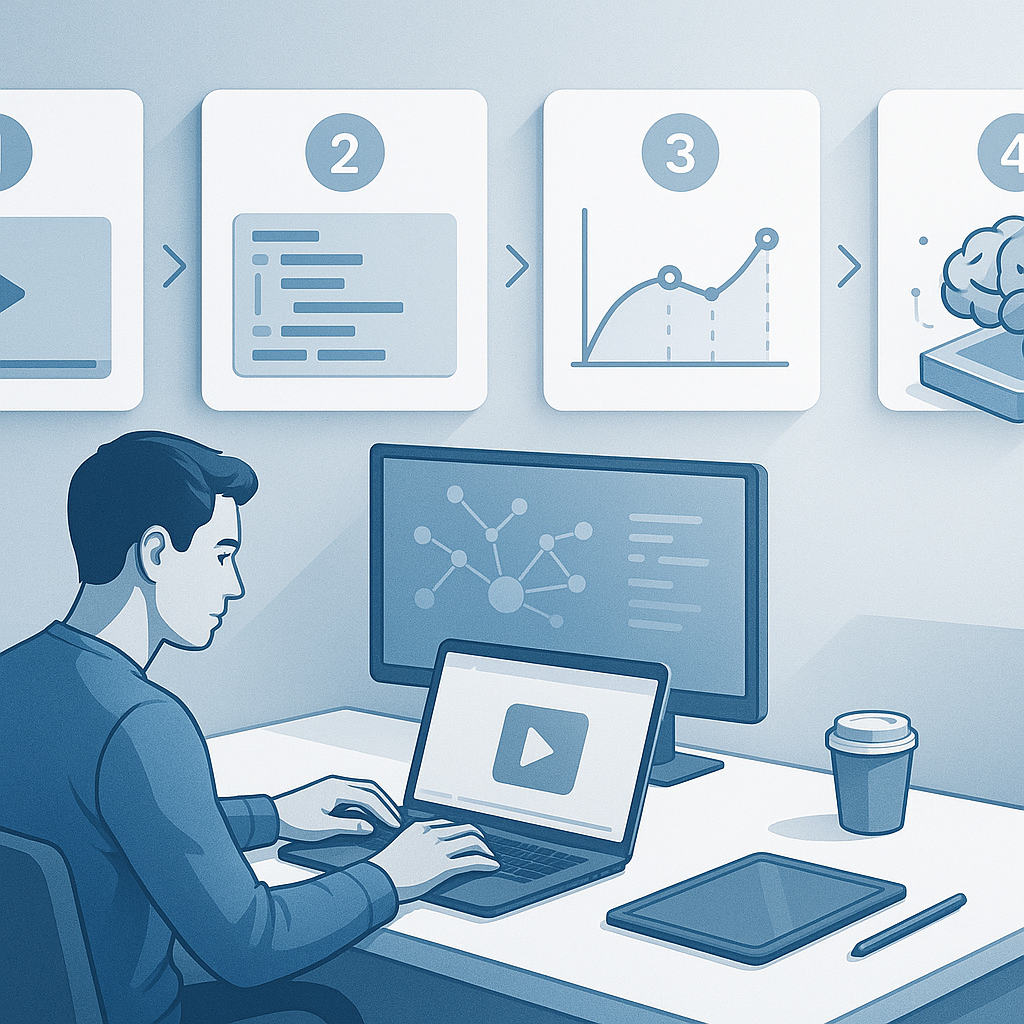
Putting it all together: the 3-step repeatable process
- Capture and distill the lecture into a one-page core concept sheet with a glossary and a quick quiz.
- Convert that sheet into multiple study materials (notes, summaries, flashcards, diagrams, and a practice set) using templates and a mix of AI assistance and human edits.
- Build an AI-enhanced study plan and a centralized study hub you can reuse across courses, with regular reviews and feedback loops to improve accuracy and retention.
FAQ Table: Not applicable
Not applicable for a separate comparison table in this guide. The emphasis here is on a practical, cohesive workflow rather than tool-by-tool comparisons.
FAQ Section
- How can I ensure accuracy when converting lectures to study materials?
- Start with source-of-truth alignment. Use the lecture slides, textbook chapters, and any instructor-provided materials as anchors.
- Validate AI outputs. If you rely on AI for summaries or questions, cross-check every key definition, theorem, and example against your course materials.
- Build a quick verification checklist: definitions correct, key steps in a process preserved, example results match the lecture, and any formulas are accurate.
- What formats should I prioritize, and why?
- Start with a concise set: 1-page notes per lecture, a short 2–4 sentence summary, 5–10 flashcards, 1 diagram, and 5-8 practice questions.
- These formats cover recognition (notes, summaries), recall (flashcards), application (practice questions), and synthesis (diagrams). They’re also modular and easy to review in short study sessions.
- How can AI help without replacing my own understanding?
- Treat AI as a productivity partner that handles repetitive drafting, formatting, and gap-filling. You provide the understanding, and AI helps you express it clearly and organize it.
- Always review and edit AI-produced content to ensure it reflects your learning and the course’s expectations.
- How do I organize materials for different courses?
- Use a consistent hub structure with course tags, module tags, and content-type tags (notes, summary, flashcards, diagram, practice).
- Create a course notebook or folder for each course, and within it, subfolders or pages for lectures, modules, and exam prep.
- Schedule weekly reviews that cycle through courses to prevent overload.
- What about citations and avoiding plagiarism?
- If you reuse or adapt content from lectures, keep track of original phrasing and sources. Add citations where required by your institution.
- When using AI, avoid copying long passages verbatim. Paraphrase in your own voice, and verify that conclusions reflect your understanding.
- How can I ensure accessibility for all learners?
- Use clear language, high-contrast diagrams, and alt-text for visuals. Create captions for audio notes if you publish them.
- Provide multiple formats (text, diagrams, audio summaries) to accommodate different learning styles and accessibility needs.
- How long does this process take, and how often should I update materials?
- A well-structured lecture-to-study-materials workflow typically takes 20–40 minutes per lecture for the initial distillation, plus 15–30 minutes to generate the main study materials in the following steps. If you’re new to the process, plan for 60–90 minutes per lecture initially.
- Update materials after each new lecture in the same course to keep everything aligned with the syllabus and avoid backlog.
- How can I customize this for different exams (midterms vs finals)?
- For midterms: emphasize the most likely topics, create targeted flashcards, and focus on problem-solving patterns that recur in the syllabus.
- For finals: expand practice questions, add comprehensive review diagrams linking multiple lectures, and develop a set of “exam-ready” summaries that distill the entire unit into a concise reference.
Conclusion
Transforming academic lectures into student-friendly study materials isn’t about reinventing the wheel—it’s about turning every lecture into a lean, reusable toolkit you can study with. Start by capturing the essentials, distill them into a compact concept sheet, and then build a mix of study formats that suit your learning style. Add AI to accelerate the repetitive parts, but keep your own understanding front and center. The result is a personalized set of lecture notes, study materials, and student resources that help you study smarter, not harder.
From my experience, this approach reduces last-minute anxiety and improves retention. Students who adopt a consistent 3-format strategy (notes, flashcards, and diagrams) tend to see higher confidence and better exam performance. If you’re looking to make a tangible change this semester, pick one topic, apply the workflow end-to-end, and measure your progress over the next two weeks.
Pro tip: Schedule a weekly 30-minute “material refresh” session. Use it to prune outdated content, update glossaries, and add a couple of new practice questions. Small, regular updates keep your study materials accurate and aligned with the course pace.
Quick note: Share your templates with classmates or a study group. You’ll get fresh perspectives, catch gaps you missed, and create a communal study resource that benefits everyone.
If you’re ready, try this 2-week pilot:
- Week 1: distill 3–4 lectures, produce notes, flashcards, and 1 diagram per lecture.
- Week 2: expand with 5–10 practice questions per lecture, refine your glossary, and build a consolidated exam-ready sheet for each course.
By embracing a deliberate, repeatable workflow—and using academic ai as a supportive tool—you’ll turn every lecture into a durable, student-friendly resource that’s easy to study, reference, and reuse across courses.